The Sensory Web: Designing for Sound, Touch, and Vision
Close your eyes and think about the brand you trust most. What do you hear? Not a jingle — a quality. A texture of sound. A weight in the silence before something starts. The most powerful brands in 2026 are not building visual systems. They are building sensory architectures: experiences that arrive in the body before they are processed by the mind.
The Vision: Beyond the Rectangle
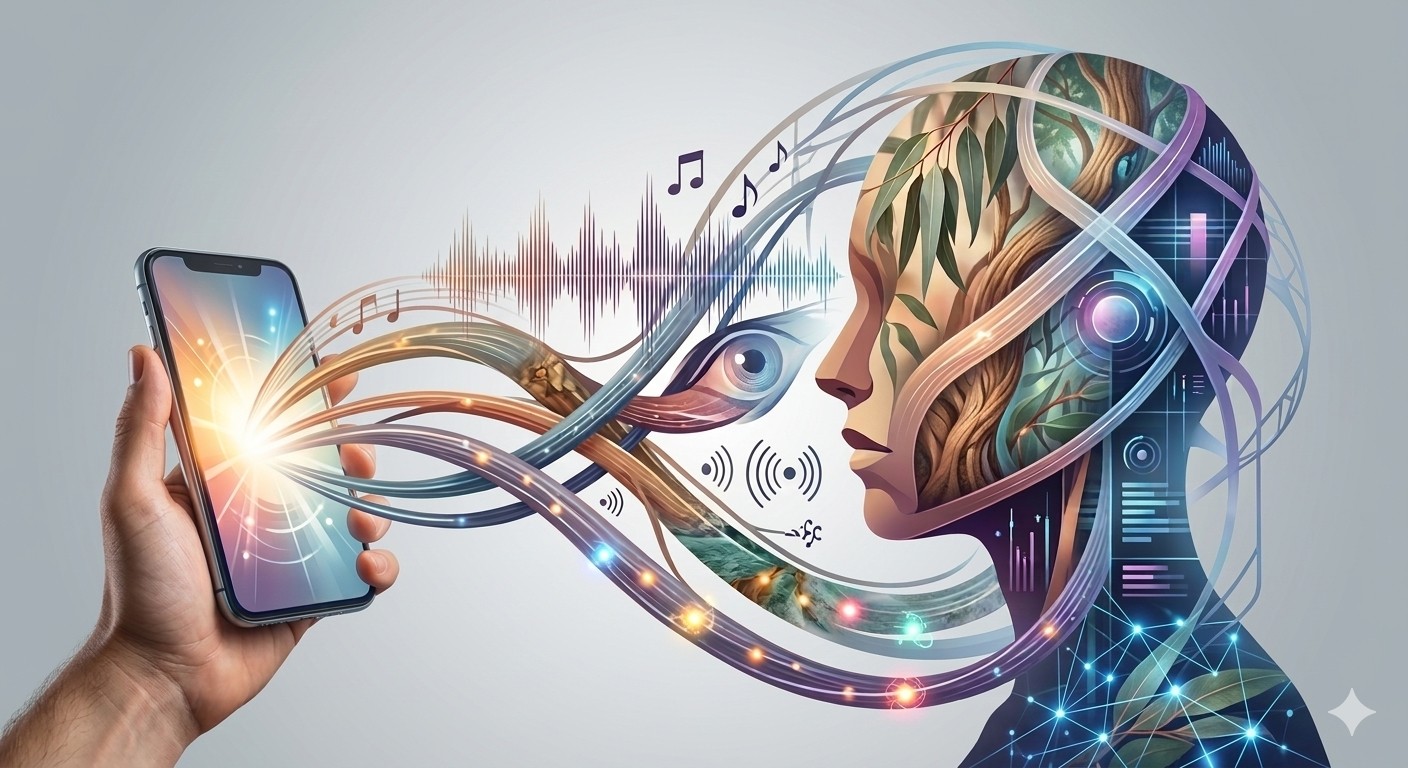
The Sensory Web is the creative frontier that emerges when AI tools achieve genuine multimodal capability — when the same generative intelligence that creates a visual can simultaneously compose its sound, calibrate its haptic response, and adapt its spatial presentation to the device and environment it inhabits. In early 2026, this frontier is no longer theoretical. It is shipping.
Adobe Firefly now generates sound effects, cinematic B-roll, and atmospheric audio layers — smoke, water, lens flares, ambient spatial sound — alongside its visual outputs. Seedance 2.0 uses unified audio-video joint generation: sound and image emerge from the same latent stream, meaning physical sound events arrive at the precise frame of their visual counterpart rather than being synchronised in post-production. Canva’s Veo 3 integration generates AI voiceovers and music sync alongside video clips. The tools are converging on a single generative act that produces sound and vision simultaneously — the way the physical world does.
For Australian creative directors and brand designers, the Sensory Web represents a creative expansion that most current brand standards are not designed for. A colour palette, a typography system, and a logo are not sufficient creative infrastructure for a world in which your brand also needs a sonic signature, a haptic grammar, and a spatial identity. The brands building this infrastructure now will be the ones whose audiences feel them, not just see them.
The Technique: Three Steps to a Multimodal Brand Experience
Step 1: Design Your Sonic Signature
A sonic logo is a three-to-five second audio identity that functions like a visual logo: instantly recognisable, emotionally consistent, and attributable without any visual context. The discipline of sonic branding is well established (think Intel, Netflix, Mastercard), but AI has made it accessible at every budget level. Using ElevenLabs for brand voice generation, Adobe Firefly’s audio features for atmospheric sound design, and Suno AI for melodic signature composition, an Australian brand can build a complete sonic palette in a single working day. The brief for your sonic signature should answer: what emotion does your brand resolve? (Trust? Delight? Relief? Energy?) What physical environment does it belong to? What is the sonic temperature — warm and resonant, or clean and precise? These answers drive the generation parameters as specifically as a colour brief drives visual design.
Step 2: Map Your Haptic Grammar
If your brand has a mobile app or web application, haptic design is the sensory layer most commonly absent from brand standards — and the one that creates the deepest sense of product quality when done well. Define three haptic moments: Confirm (a gentle, warm double tap that says “yes, that worked”), Alert (a sharper single pulse that says “attention needed”), and Delight (a gentle rising pattern for moments of reward or achievement). In iOS, these map directly to UIImpactFeedbackGenerator intensity values (.light, .medium, .heavy) and UINotificationFeedbackGenerator types (.success, .warning, .error). In Android, VibrationEffect.createWaveform() gives pattern-level control. The brand specification is not the code — it is the intention: “when a customer completes a purchase, the haptic response should feel like a warm handshake, not a mechanical beep.”
Step 3: Build Your Reality Warp Visual Layer
Canva’s Reality Warp trend — the deliberate blending of photographic reality with surreal, AI-generated elements — is the visual expression of the Sensory Web’s ethos: creative that exists between what is real and what is imagined. For Australian brand photographers, the practical technique is composite layering: start with a practical photography base (your own original photography of real Australian environments, people, and products), then add AI-generated surreal elements in Adobe Photoshop using Firefly’s Generative Fill. The rule is that the AI element should feel like it belongs in the same physical space as the photograph — same lighting, same depth of field, same grain — rather than composited on top of it. When done correctly, the viewer should feel the uncanniness rather than see the seam.
The Soul Check: Does Multimodal Design Overload or Enchant?
The creative risk of the Sensory Web is sensory excess: a brand that fills every channel with generated content, sound, haptics, and motion until the experience becomes overwhelming rather than immersive. The test for a multimodal brand experience is subtractive. Remove the sound: does the visual stand alone with full impact? Remove the haptic: does the interaction still communicate clearly? Remove the motion: is the still moment just as powerful? Each sensory layer should amplify the others, not compensate for their absence. The highest-quality Sensory Web experiences are the ones where you don’t notice any individual layer — you just feel the brand.
Australia has one of the most distinctive natural sonic environments on the planet — and it is almost entirely absent from Australian brand sound design. Brief your sonic signature generator with specific AU environmental references: the particular resonance of eucalyptus forest ambient sound, the acoustic quality of corrugated iron in coastal wind, the silence between cicada pulses at dusk. These are not “nature sounds” — they are specific cultural markers. In ElevenLabs or Suno AI, describe them with the same precision you would use to brief a photographer: “dawn, 45° north of Sydney, sparse bird call, still air, low-frequency earth resonance, not romantic — ancient.” The specificity is what creates the brand distinction.